waar bent u naar op zoek?
A fuel tank heat shield reduces heat reaching the tank from nearby exhaust components and other external sources. It may be a reflective laminate on an approved surface or a separate shield positioned between the tank and the exhaust. The correct design depends on the heat path, tank construction, attachment and available space, not just the temperature rating printed on a material data sheet.
For a metal tank, the coating may determine whether an adhesive-backed barrier can be used. For a plastic tank, the exact polymer and surface condition become critical. In either case, a universal heat shield sheet should not be treated as an automatic replacement for the vehicle's original tank shield.
BSTFLEX supplies reflective heat barrier sheets and mats for application review. This guide focuses on selecting material for an external fuel tank barrier, rather than modifying the tank or its fuel system.
A fuel tank beside an exhaust pipe may receive substantial radiant heat on one wall. It may also be exposed to hot underbody air or heat conducted through adjacent structures. In some fuel systems, pump operation or returning fuel adds heat internally. An external reflective barrier addresses only the heat paths its position and construction can influence.
Identify the protected quantity before choosing a material: tank-wall temperature, fuel temperature, or the temperature of a nearby line or component. These are different measurements. A cooler exterior patch does not prove the entire fuel volume is cooler, and a tank shield does not automatically resolve overheating elsewhere in the fuel circuit.
Where the affected part is a hose rather than the tank, review a component-specific fuel-line heat protection sleeve. Keep that requirement separate from the sheet material specified for the tank area.
Do not approve a bond on bare aluminum and assume the result applies to painted steel. An adhesive attaches to the surface it contacts: paint, coating or contamination can matter more than the underlying metal. Record the tank finish and use representative production surfaces for the adhesion trial.
Confirm that the proposed preparation and adhesive are compatible with the tank manufacturer's requirements. Do not remove protective coatings merely to improve initial tack. Where an approved bonding surface is unavailable, evaluate a separate supported shield instead of forcing an adhesive solution.
A plastic fuel tank heat shield needs more than an adhesive described as high temperature. Polyethylene and polypropylene are low-surface-energy plastics and can be difficult to bond with ordinary tapes. Adhesion to a painted test panel does not establish compatibility with a polyethylene tank.
Identify the actual outer surface, including any treatment, texture or coating. Request backing compatibility for that surface and confirm it with the tank supplier. A multilayer tank should not be specified for bonding simply by naming an internal barrier layer.
Do not use flame treatment, uncontrolled heating or unapproved solvents on an installed fuel tank to make a sheet adhere. Where bonding cannot be qualified, change the attachment concept. The peel and stick heat shield guide covers the general adhesive selection questions.
On the tank exterior. A bonded patch can be considered only when the tank surface, adhesive and installation have been approved for the application. The reflective side faces the radiant source; the adhesive interface remains subject to its own temperature limit. Keep the tank's movement and service requirements in the design.
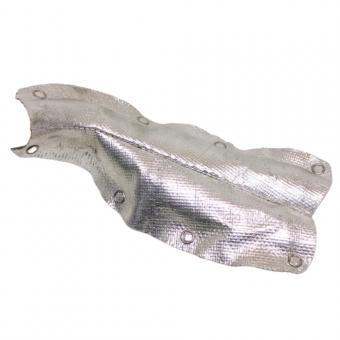
On a separate carrier or bracket. A supported barrier can interrupt the radiant path without relying on adhesion to the tank. The carrier, mounting locations and retained clearance are part of the assembly. A flexible mat is not a self-supporting metal panel and needs an appropriate support arrangement.
On an adjacent body panel. This may protect that panel, but it will not necessarily protect the tank. Check whether the chosen position actually lies between the hot source and the tank area of concern. Convenient access is not sufficient evidence that the location will work.
Maintain required original shielding unless a replacement assembly has been approved. Do not drill or screw into the tank to attach a barrier. A thermal sheet is not a fuel-leak repair or a fire-containment system.
Once the installation surface and mounting arrangement are defined, compare the complete laminate. The following BSTFLEX products provide material starting points; the product listing alone does not approve direct attachment to every tank.
| Material option | Construction | Fuel-tank project check |
|---|---|---|
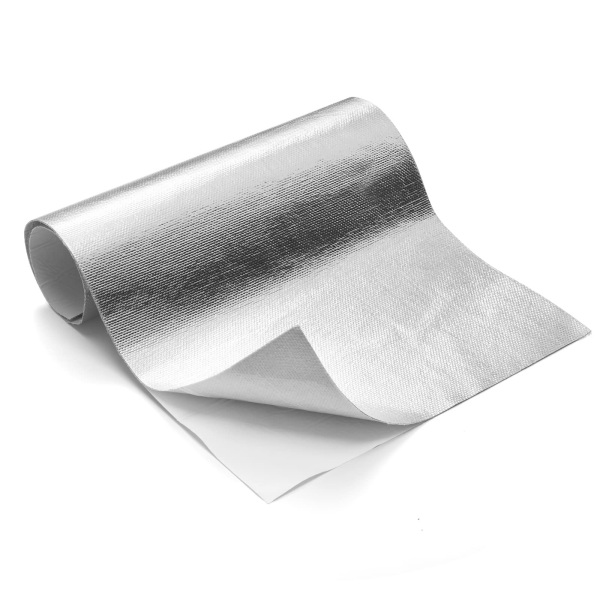
| Adhesive-backed aluminum silica heat shield barrier | Woven silica substrate, reflective facing and adhesive backing. | Confirm backing compatibility, interface temperature and whether bonding is to the tank or a separate approved surface. |
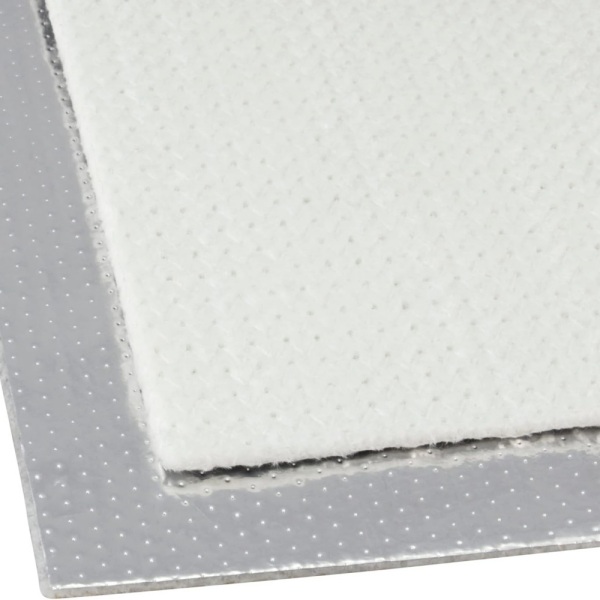
| Adhesive-backed aluminum fiberglass heat shield mat | Aluminum reflective face, fiberglass layer and adhesive backing. | Evaluate installed thickness, contour fit and attachment after the specified thermal and environmental exposure. |
| Aluminum silica thermal barrier mat | Woven silica with a reflective facing; specify the supplied backing and fixing method separately. | For a supported design, define the carrier, edge restraint and mounting loads instead of assuming the textile supports itself. |
A silica or fiberglass temperature figure is not the allowable temperature of the tank, mounting adhesive or complete laminate. Specify the facing, substrate, interlayer bond and attachment as one construction, while checking the limit of each relevant layer.
A fuel tank insulation request sometimes becomes a full-wrap proposal before the heat source has been identified. Start with the exhaust-facing area. Map the exposed wall and inspect the paths around its corners, seams and mounting features.
For example, where an exhaust pipe runs beside one tank wall, a correctly positioned side barrier may address the identified radiant exposure without covering unrelated surfaces. This is a layout option to evaluate, not a validated design for every vehicle. Coverage must still account for the actual source geometry and operating movement.
Full coverage changes heat exchange over a larger area and may also restrict heat leaving the tank. Do not assume more coverage always means a lower fuel temperature. Preserve ventilation, drainage and service functions, and verify the proposed coverage against the actual thermal objective.
Record the minimum separation between the exhaust and the installed shield, not just the distance to the bare tank. Include material thickness, seams, brackets and possible deflection. Allow for exhaust expansion and movement of the tank and its supports within the vehicle's specified operating conditions.
There is no universal exhaust-to-fuel-tank distance that can be approved from a generic sheet description. Use the vehicle and tank manufacturer's requirements and the validated installation. A thicker barrier cannot be assumed to compensate for insufficient separation, especially if it creates contact.
Where an original stand-off shield creates a deliberate air space, replacing it with a bonded mat changes the arrangement. Evaluate that as a design change, not a like-for-like material substitution.
Show tank straps, support pads, filler and vent connections, fuel lines, wiring and access points on the coverage drawing. Do not introduce an unapproved layer beneath a tank strap or change the support arrangement simply to retain a flexible mat. The barrier must not interfere with the tank's restraint or load distribution.
Keep drain paths and inspection areas accessible. Review where dirt, water or leaked fluid could collect at an edge or between layers. Fluid exposure needs a material-compatibility requirement; the word aluminized does not establish fuel resistance or suitability for fuel immersion.
For underbody locations, evaluate splash, abrasion and attachment durability. A thin reflective laminate is not a substitute for impact protection. Include any additional guard or carrier in the thermal assessment rather than treating it as an unrelated accessory.
Define acceptance limits and measurement positions with the responsible vehicle or fuel-system engineer. An exterior wall measurement, adhesive-interface measurement and fuel-temperature measurement answer different questions. Use approved instrumentation methods; do not modify the tank to install a sensor as part of an informal material trial.
Record fuel type and fill level, ambient conditions, vehicle load, exhaust configuration and airflow. Keep these conditions comparable when evaluating candidates. Include the relevant running, low-speed and post-shutdown periods so the assessment does not end before a delayed temperature peak.
Compare the proposed shield with the approved reference assembly. Do not remove required original shielding merely to create an unshielded road-test baseline. After the agreed exposure, inspect the laminate, bond, edges, supports and clearances as well as the recorded temperatures.
Report any temperature reduction only for the tested arrangement. A reflectivity percentage is not a guaranteed reduction in fuel temperature, and an external barrier should not be sold as a universal cure for vapor lock or fuel-system faults.
Send the tank material and outer finish, an assembly view showing the exhaust, the intended shield location and the available space. Add the protected-side temperature target, mounting proposal, environmental exposure and required approval criteria. Identify unknown operating values as development items.
A useful inquiry might read: We need a reflective barrier between an exhaust pipe and a plastic fuel tank. Direct tank bonding is not yet approved. Please quote candidate materials for the attached supported-panel layout, with the available thickness, sample quantity and temperature targets shown.
This example distinguishes the material request from approval of the tank attachment. For repeated shapes, BSTFLEX can review custom die-cut heat barrier parts with specified contours and openings. Material construction, conversion details and the finished sample are confirmed for the project.
For sheets, converted components and production planning, see our heat barrier material and OEM supply services. Provide prototype and production quantities separately so the quotation matches the intended supply format.
Only after the tank manufacturer permits the attachment and the backing is validated for the exact outer surface and service conditions. A generic high-temperature adhesive specification does not establish compatibility with polyethylene or another tank polymer.
Not automatically. Identify the external heat path and compare localized shielding with any wider coverage proposal. Full wrapping changes heat exchange and can interfere with service or drainage. Approve the layout against the actual tank and fuel-temperature requirements.
Not as an assumed equivalent. The original shield may rely on its stiffness, spacing and mounting arrangement. Any replacement needs approval for the complete thermal and mechanical design, not just the sheet material.
It may address an identified external heat input, but it is not a guaranteed remedy. Fuel temperature, pressure, fuel properties and heat elsewhere in the circuit must be assessed. Diagnose the system before selecting a tank barrier as the solution.
Send your fuel tank heat shield layout to BSTFLEX with the tank surface, operating conditions and required quantity. The quotation can then address an appropriate material construction rather than an undefined request for high-temperature insulation.

No.10, Chuangxin North Road, Nanshan Park, Ningguo Economic and Technological Development Zone, Ningguo City, Anhui Province, China
tel/Whatsapp : 0086-15856303740
e-mail : sales@bstbraidedsleeve.com
Skype : vanesa-cheng